Chimney flashing repair means fixing or replacing the metal that seals the joint where your chimney comes through the roof: the apron across the front, the step flashing up the sides, the counter flashing set into the brick, and the back pan or cricket behind it. When any one of those pieces fails, water runs down the outside of the chimney, slips behind the metal, and shows up as a stain on your ceiling or wet wood in the attic.
It’s one of the most common roof leaks on older Pittsburgh houses, and it’s usually fixable without touching the rest of the roof. Chimney flashing is roofing work, and it’s part of what our roof repair in Pittsburgh crew handles. Chimney masonry is a different trade: if the brick, mortar or crown is falling apart, a mason handles that part, and we’ll say so before any metal goes on.
Short answer: chimney flashing is a layered metal system, not a single piece. A lasting repair replaces the failed layers in the right order, while a bead of caulk only buys you time.
How Roof and Chimney Flashing Works
A chimney is a big hole in your roof, and it moves differently than the roof around it. The brick stack sits on its own foundation, while the roof deck flexes with temperature and load. Flashing has to bridge that gap without being locked to both sides, so it’s built in overlapping layers that shed water downhill.
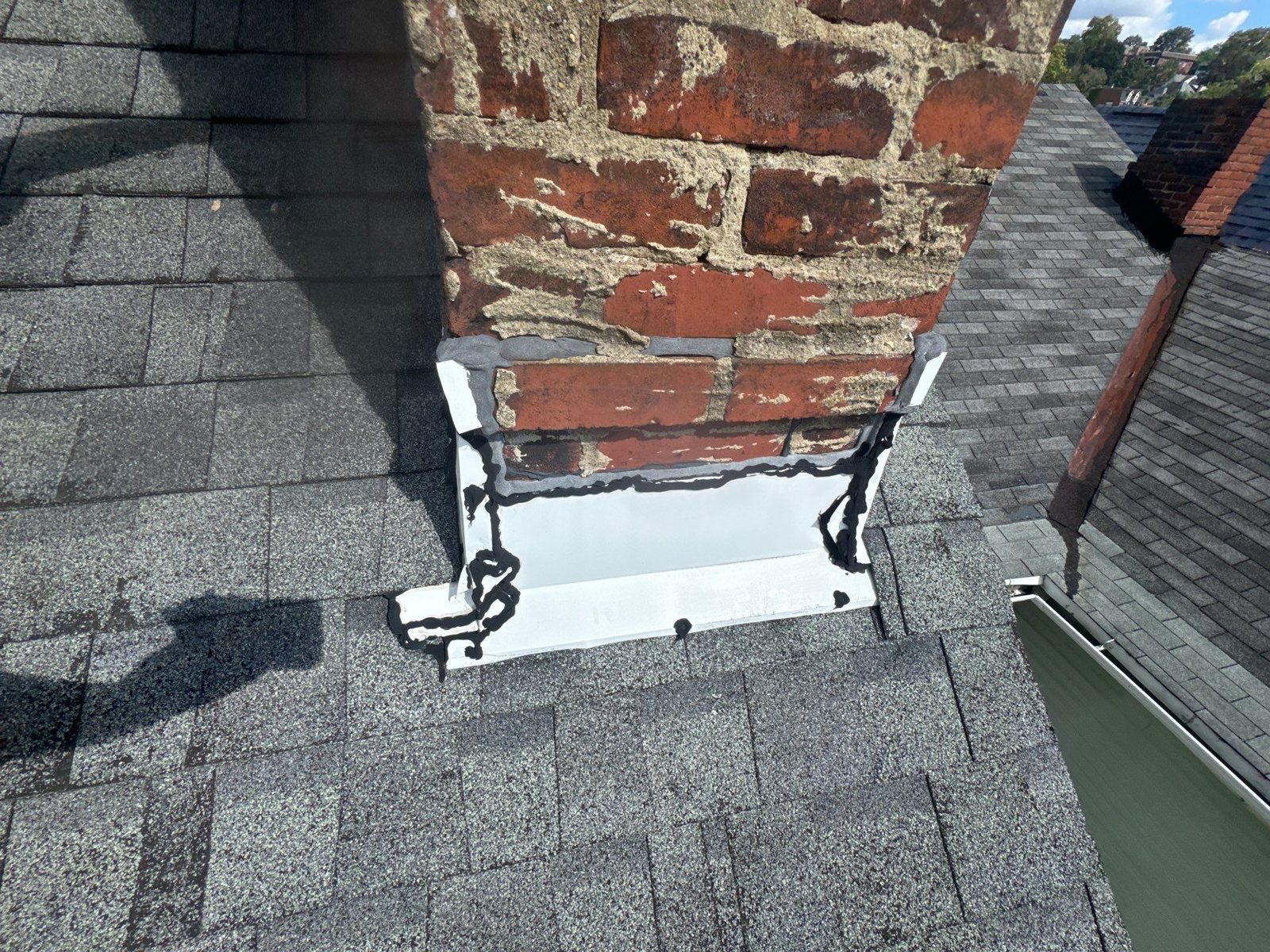
Apron (base) flashing wraps the downslope face of the chimney and laps out over the shingles, so water running down the brick lands on the roof instead of behind it.
Step flashing runs up both sides in individual L shaped pieces, one per shingle course. Each piece is nailed to the roof deck, never to the brick, and tucked under the shingle above it.
Counter flashing is the top layer. It’s set into a slot cut in a mortar joint and bent down over the step flashing, so the roof and chimney can move without tearing the seal.
New white aluminum flashing wrapped around the base of a red brick chimney, Pittsburgh, Alan Construction.
Behind the chimney, on the uphill side, there’s either a back pan (a single bent piece of metal) or a cricket, a small peaked structure that splits water and snow around the stack. If any one layer is missing or installed out of order, the whole system leaks.
Is chimney flashing required by code?
Yes. Pennsylvania’s residential code, based on the 2018 International Residential Code, says flashing must be installed at wall and roof intersections and around roof openings. It also says chimney flashing has to follow the shingle manufacturer’s printed instructions, and that a cricket or saddle goes on the ridge side of any chimney more than 30 inches wide. You can read the roof sections of the Pennsylvania residential code, chapter 9 yourself.
Signs Your Chimney Flashing Needs Repair
Most homeowners find a flashing problem from the inside. Look for these signs:
- A brown water stain on the ceiling or wall next to the chimney, often growing after heavy rain or snowmelt.
- Damp or darkened roof sheathing, rafters or insulation around the chimney when you look from the attic with a flashlight.
- Rust streaks running down the brick or onto the shingles below the chimney.
- A visible gap where the counter flashing has pulled out of the mortar joint.
- Thick globs of black tar or caulk smeared over the metal, a sign someone has patched it before.
- Lifted, cracked or missing shingles along the sides of the chimney.
One honest caution: not every chimney leak is a flashing leak. Water can also come through a cracked chimney crown, porous brick or a missing cap, and those are masonry or chimney sweep problems. A good roofer checks the flashing first, then tells you plainly if the water is coming from somewhere metal can’t fix. For a deeper look at why flashing fails in the first place, read our post on what causes roof flashing leaks around chimneys.
Chimney Flashing Repair: What a Proper Job Looks Like
A real chimney flashing repair isn’t a tube of sealant. When the metal has failed, the fix is to take the area apart and rebuild it in the right order.
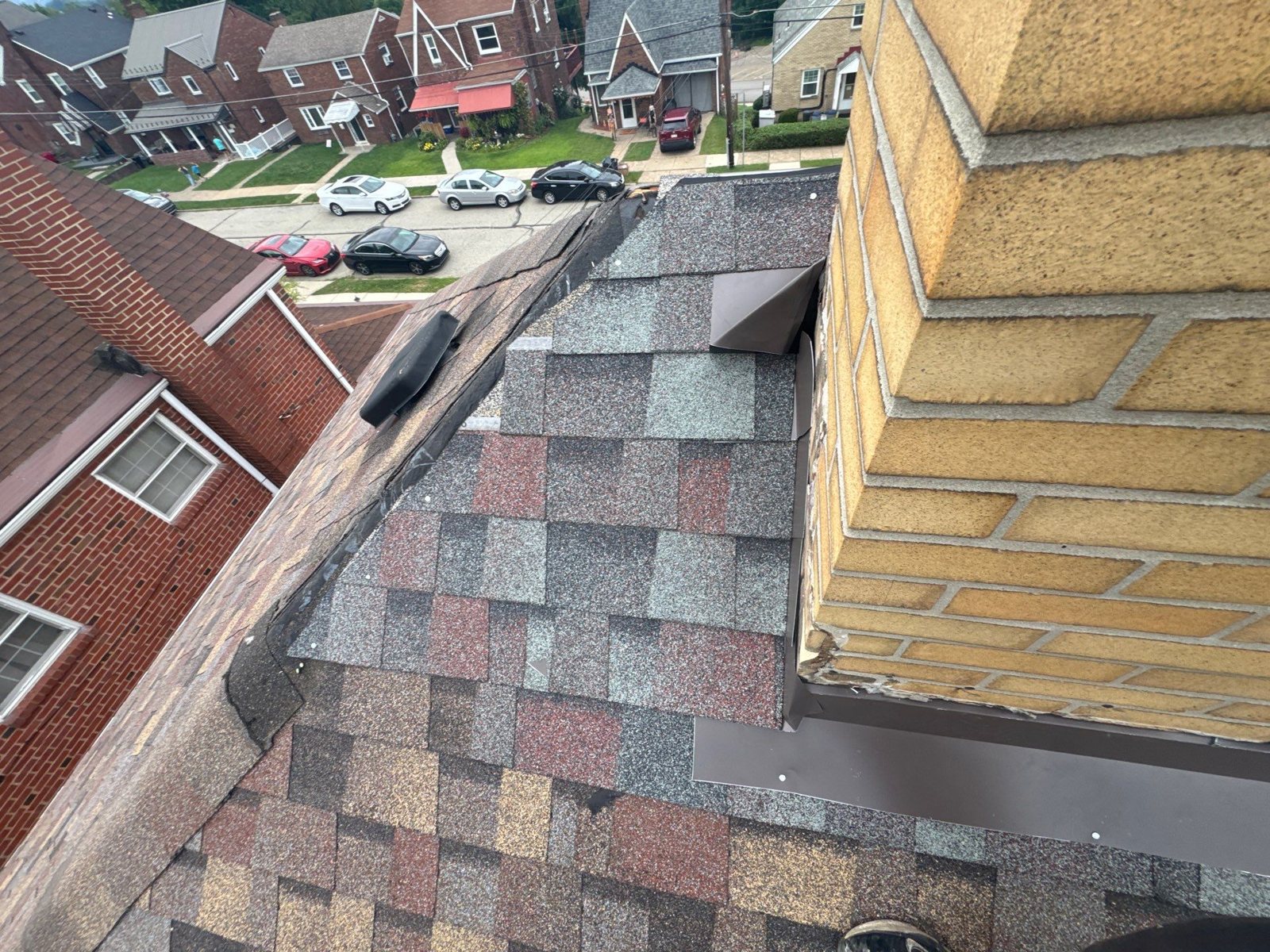
This Munhall chimney shows the side detail. The shingles run right up to the brick, and the metal turns up the chimney face so water running down the side lands on the roof instead of behind it.
On a side like this, the step flashing underneath is woven in with every shingle course. Water that gets under one shingle hits a piece of metal and is sent back out on top of the next one down.
Brown metal flashing along the side of a yellow brick chimney on multicolor shingles, Munhall, Alan Construction.
- Inspect from inside and out. We look at the attic side first to see where the water actually tracks, then check every layer on the roof.
- Remove shingles around the chimney. Usually a course or two on each side and the uphill area, enough to reach the old metal cleanly.
- Check the roof deck. Wood that has been wet for a while gets soft. Soft sheathing gets replaced before anything goes over it.
- Add ice and water protection. A self adhering membrane goes around the base of the chimney as a backup layer under the new metal.
- Install the apron, then the step flashing course by course as the shingles go back on.
- Install the back pan or cricket on the uphill side, lapped so water is shed around the chimney.
- Set the counter flashing. A slot is cut into a mortar joint, the counter flashing is set into it and sealed, and it’s bent down over the step flashing.
- Clean up. Old metal and shingles are hauled off, and we run a magnetic sweep for nails.
Does chimney flashing go under or over shingles?
Both, depending on the piece. The apron sits on top of the shingles at the front. Each step flashing piece goes over the shingle below it and under the shingle above it. The back pan or cricket goes under the shingles uphill of the chimney, so water flows over the metal and away. Get that order wrong and the flashing funnels water in instead of out.
Crickets: Why Wide Chimneys Need One
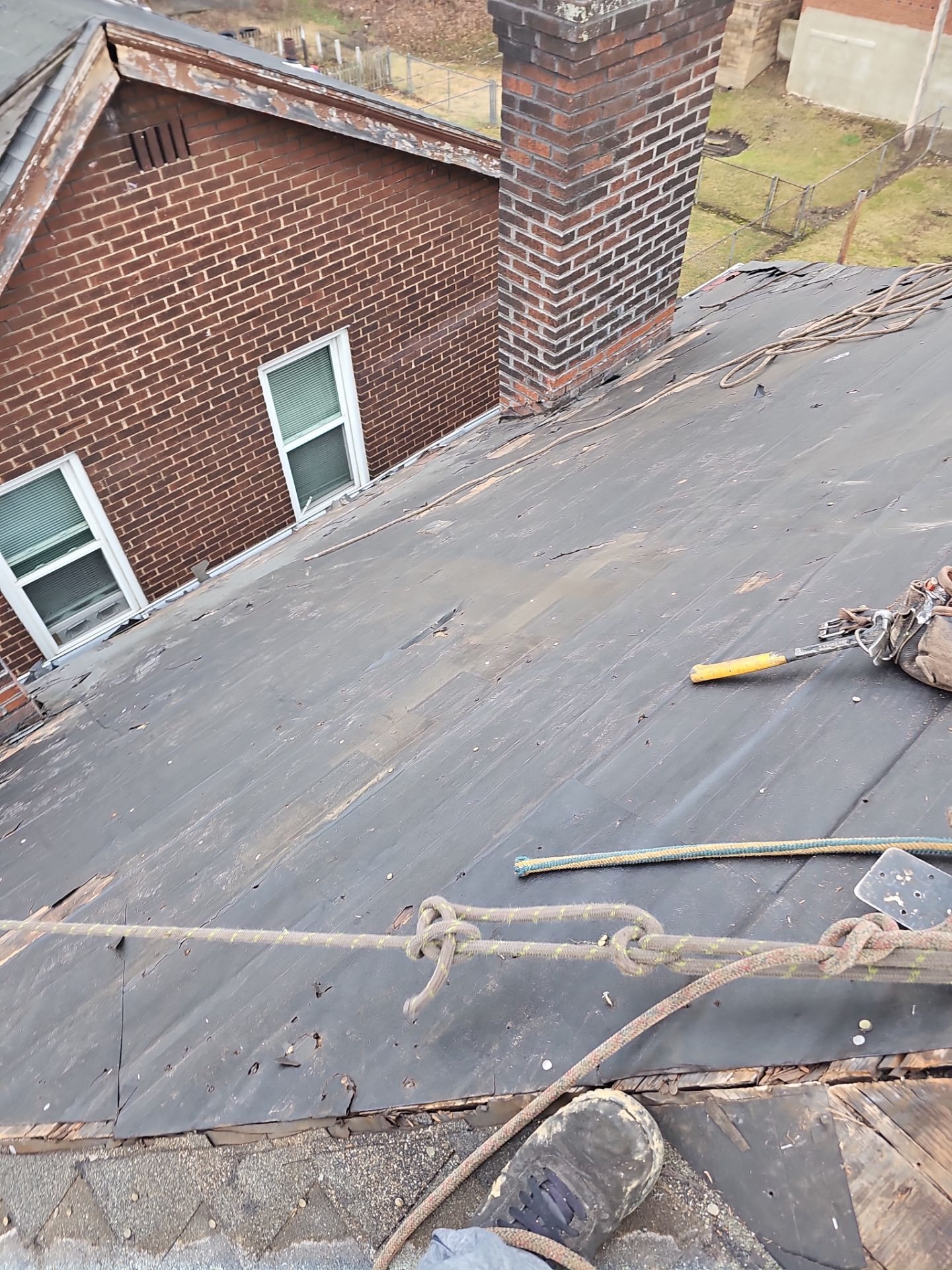
The uphill side of a chimney takes the most water. Everything that runs down the roof above it hits the brick and has to go somewhere. On a narrow chimney, a well formed back pan handles it.
On a wider chimney, water and snow pile up against the brick and sit there. That’s why the code calls for a cricket on chimneys more than 30 inches wide. On older Pittsburgh houses with wide stacks and no cricket, adding one during a flashing repair is often the real fix for a leak that keeps coming back every winter.
Old worn low slope roofing near a brick chimney, Pittsburgh, Alan Construction.
Repair or Replace the Flashing?
Not every flashing problem means all new metal. Here’s how we usually sort it out:
| What we find | What usually fixes it |
|---|---|
| Sealant cracked, metal still sound and properly set | Clean and reseal, reset any loose counter flashing |
| One or two step flashing pieces bent or rusted | Lift the shingles and replace those pieces |
| Counter flashing caulked or nailed to the brick face with no slot | Cut a slot in the mortar joint and install new counter flashing |
| Metal rusted through, or one long bent strip instead of step pieces | Replace the full flashing system |
| Wide chimney with no cricket and repeat winter leaks | Build a cricket and flash it |
| Crumbling mortar, loose brick or a cracked crown | Mason repairs the chimney first, then new flashing goes on |
If your roof is near the end of its life, it usually makes sense to do the flashing with the new roof instead of patching it twice. Our guide to roof replacement vs. repair walks through that decision. On any replacement, new chimney flashing should be listed in writing on your estimate.
How to Install Roof Flashing Against a Wall
A chimney isn’t the only place a roof meets something vertical. Dormers, second story walls, porch roofs and skylights all use the same idea, and the code is specific: base flashing against a vertical sidewall has to be step or continuous flashing at least 4 inches tall and 4 inches wide, and it has to send water away from the wall.
On a sided wall, step flashing goes in with each shingle course, the same as on a chimney, but the siding and house wrap lap over the top of it instead of counter flashing. That lap is what keeps water from running down behind the metal.
At the bottom of the wall, where the roof edge ends, a kickout flashing turns water into the gutter. Without it, water runs straight into the wall.
Openings like this skylight get the same treatment: underlayment first, then step flashing up the sides and a pan across the top.
Skylight opening framed in new roof decking, Oakdale, Alan Construction.
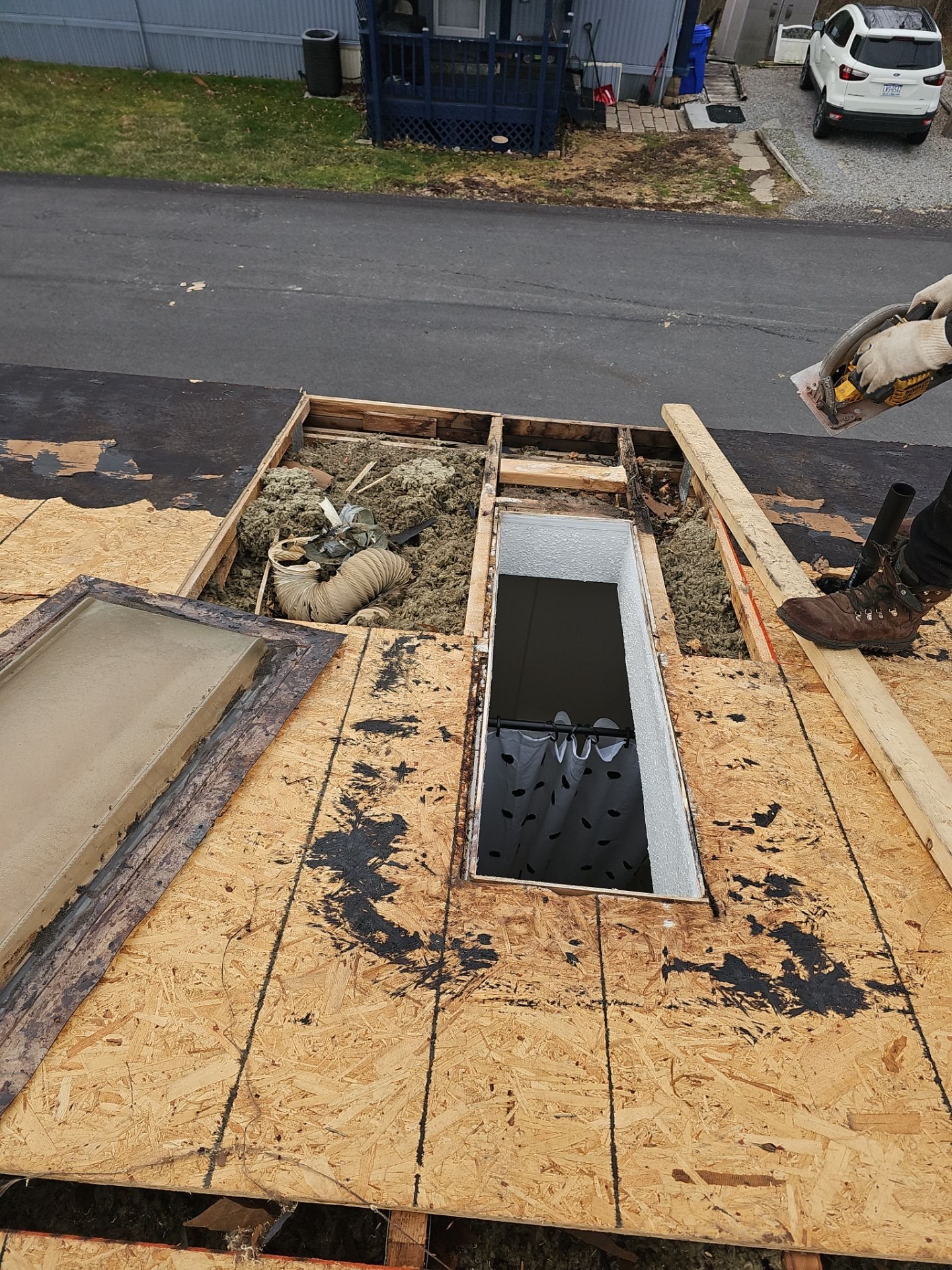
On a brick wall, the top edge gets counter flashing set into a mortar joint, just like a chimney. On a sided chimney chase, the siding does that job instead.
Why Pittsburgh Chimneys Leak So Often
Our winters are hard on flashing. Snow piles up behind chimneys, melts during the day and refreezes at night, and every cycle works at the seams and the mortar joint holding the counter flashing. Plenty of older brick houses around Pittsburgh have flashing that has been patched more than once, often with tar over tar.
If you see a new stain after a thaw, get it looked at before the next round of storms. Alan Construction has served Pittsburgh since 2003, we’re registered as a home improvement contractor (PA#126638), and you can confirm any contractor’s registration on the Pennsylvania Attorney General’s site.
Roofer or mason: who to call
Call a roofer when the problem is the metal, the shingles around the chimney, a missing cricket or a leak where the chimney meets the roof. Call a mason when the brick itself is failing: crumbling joints, loose or spalled brick, a cracked crown or a leaning stack. Sometimes you need both: mason first, then roofer.
Seeing a stain near your chimney or water in the attic? Contact Alan Construction for a free, no obligation estimate, and we’ll show you exactly where the water is getting in.