Shingles losing granules is usually a sign of UV exposure, freeze thaw swings, storm impact or ordinary aging weakening the bond between the mineral surface and the asphalt underneath. A light dusting in your gutters is normal; start worrying when you see bald patches, a sudden surge of shedding after a storm, or grit piling up deep in the gutters. If you find the warning signs below, a roof repair in Pittsburgh caught early costs far less than the damage that follows.
We’ve looked at a lot of roofs across Pittsburgh’s East End, and granule loss is one of the most misread things we run into. Homeowners either panic over a coffee cup of grit at the downspout or shrug off a roof that’s been quietly shedding for years. The honest answer sits in the middle, and it’s readable once you know the difference between a roof that’s aging and a roof that’s failing.
Short answer: even, light shedding on an older roof is normal wear. Patchy bald spots, heavy loss right after a storm, or exposed fiberglass mat mean it’s time for a professional inspection.
What granules actually do on your roof
Granules aren’t decoration. They’re crushed rock with a ceramic coating, pressed into the asphalt while the shingle is still hot. They act as sunscreen for the asphalt below, add fire resistance, absorb the energy of falling hail and debris, and give your roof its color.
Strip them away and the asphalt starts drying out under direct sun. It hardens and eventually cracks. That’s the whole reason granule loss matters: the missing grit isn’t what leaks, it’s what happens to the exposed asphalt over the next few summers.
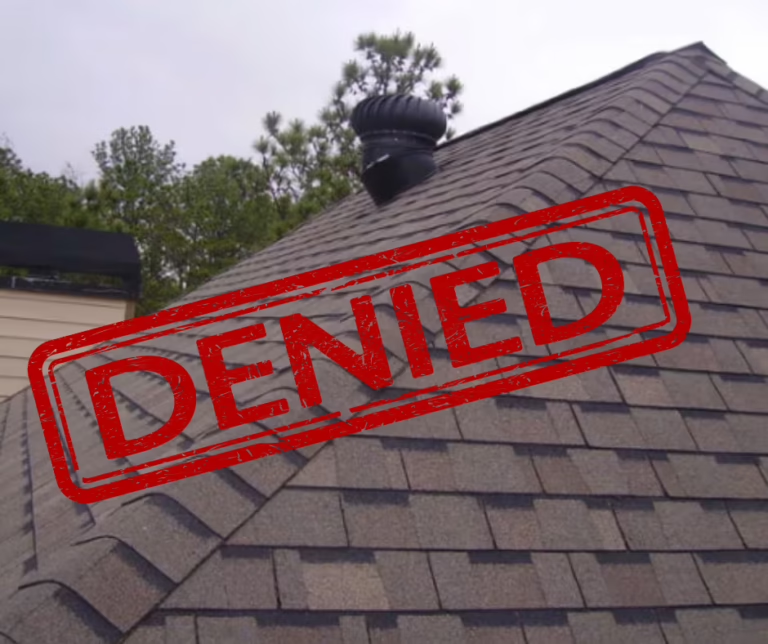
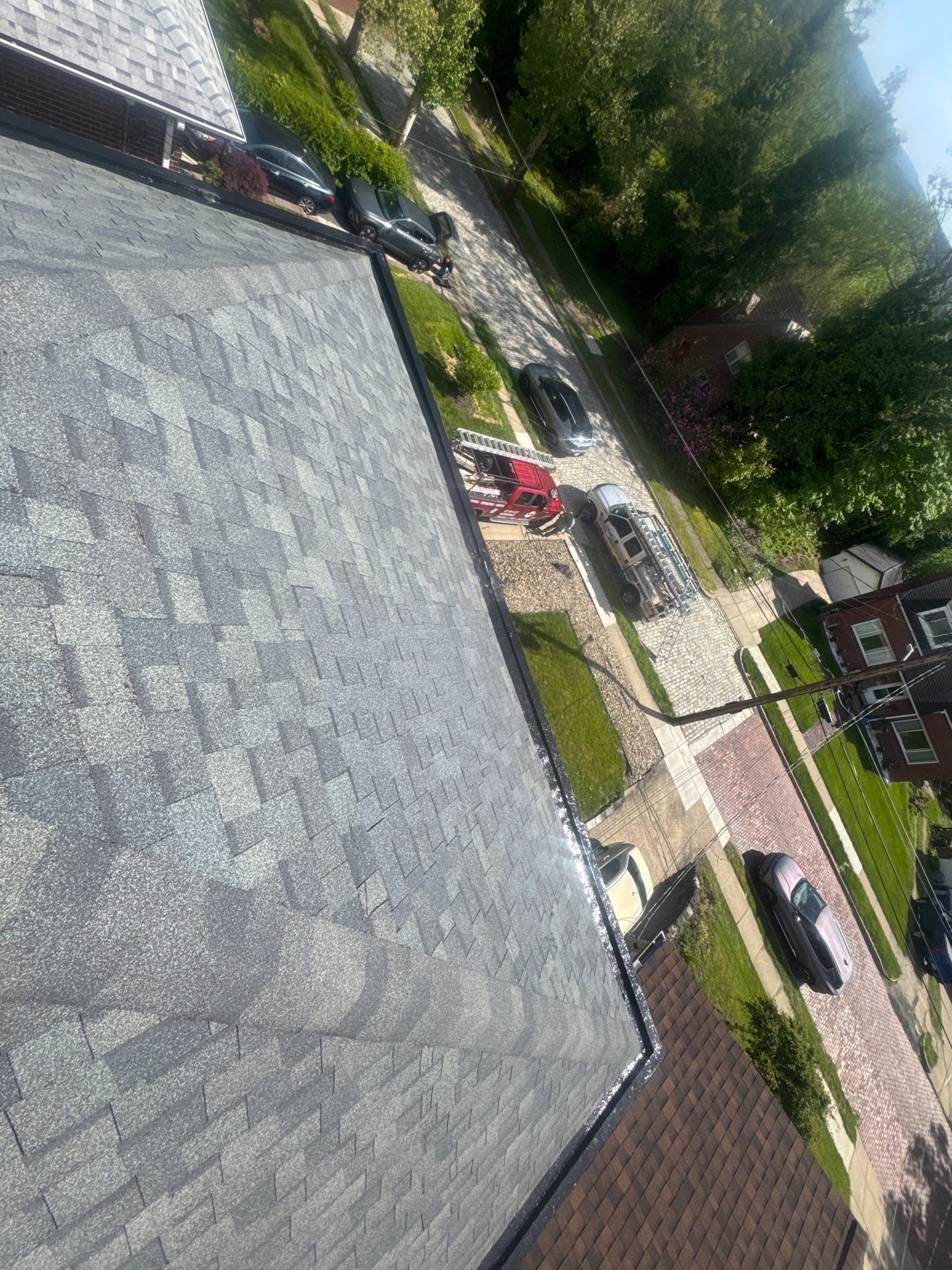
New gray shingles along a roof edge above a Pittsburgh street, Alan Construction.
Why shingles lose granules on Shadyside homes
There’s rarely one culprit. Usually it’s two or three working together over a decade.
Age and sun
Every roof sheds. As shingles age, the asphalt loses its oils, hardens and stops gripping the granules. South and west facing slopes go first because they take the most sun. If the loss is even across the whole roof and the roof is old, that’s weathering, not damage.
Weather and impact
Hail loosens granules even when it doesn’t crack anything, and older shingles give them up to small stones. Heavy runoff from an upper roof onto a lower one carves visible bare tracks. Then there’s our freeze thaw cycle: water works into the granule bed, freezes, expands and pops granules loose. If you suspect a storm, our guide to the signs of hail damage on asphalt shingles shows what to look for.
Trees, feet and pressure washers
Shadyside’s tree canopy is one of the best things about living here and one of the worst things for a roof. Overhanging limbs scrape shingles in every windstorm and drop debris that holds moisture against the surface. Add foot traffic from satellite installers or holiday lights, plus the occasional well meaning pressure washing, and you get patchy granule loss that homeowners often mistake for storm damage.
What does granule loss on shingles look like?
From the ground, look for color that isn’t consistent. Healthy shingles read as one uniform tone. Failing ones look blotchy, shiny, or streaked with darker patches where the asphalt shows through. Those dark spots are the real tell.
At the gutters, you’re looking for what most people describe as black sand. A thin film after a new roof install is leftover loose granules from manufacturing and stops within a few months. A steady buildup on an older roof is a different story. Check the splash block under each downspout, because that’s where it collects first.
The advanced version is hard to miss. Shingles look thin and worn, edges curl or lift, and in the worst cases you can see the fiberglass mat itself. At that point the shingle isn’t shedding water reliably anymore.
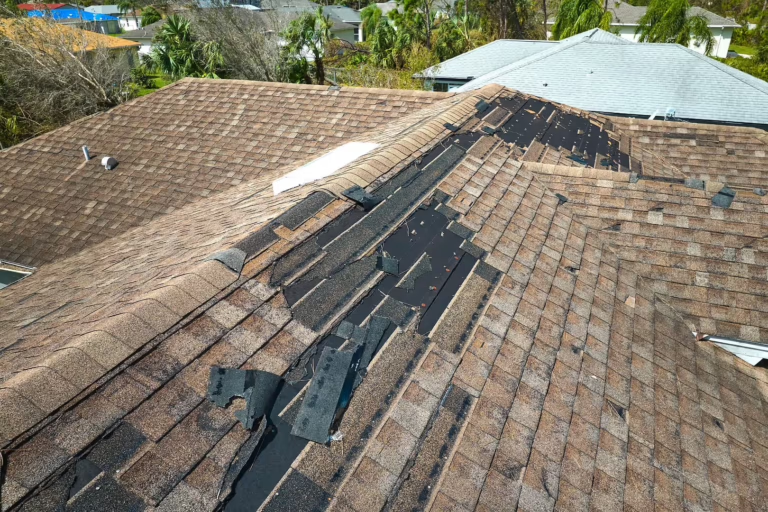
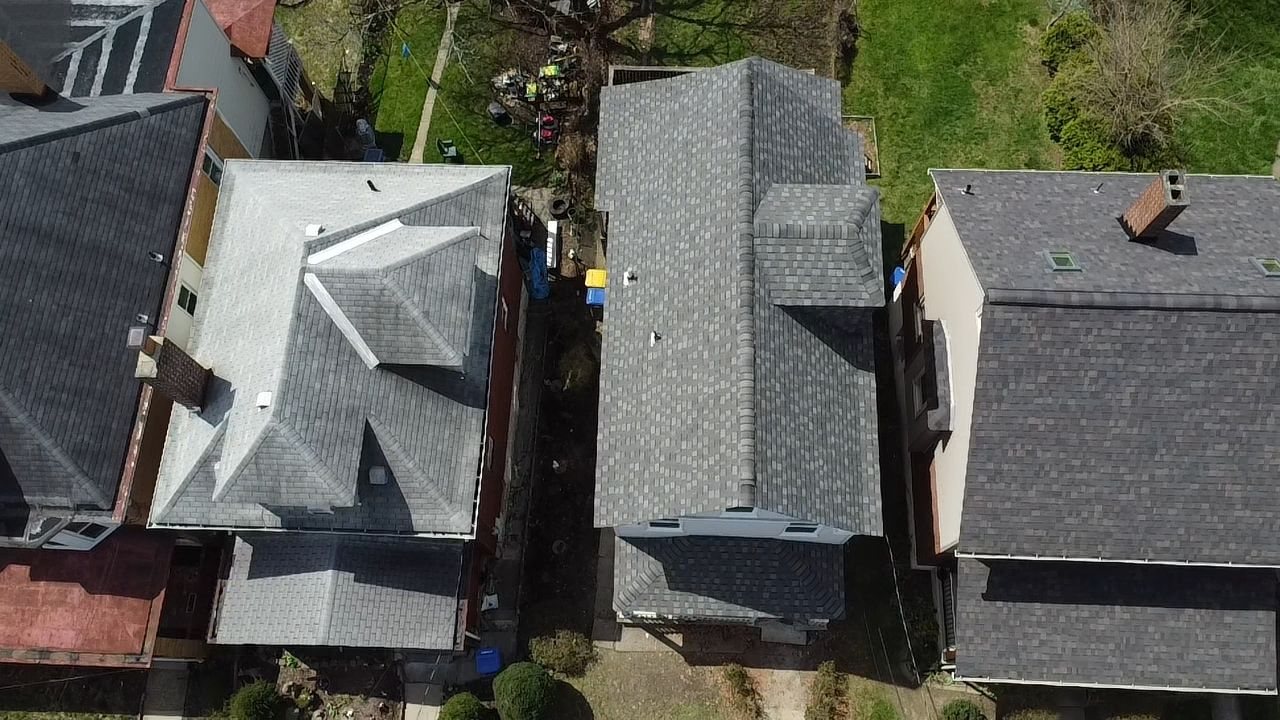
Drone view of several gray shingle roofs on a Pittsburgh block, Alan Construction.
How much granule loss is too much for shingles?
Here’s the rough scale we use when we’re walking a roof, and it lines up with standard inspection guidance from InterNACHI.
| What you’re seeing | What it usually means | What to do |
|---|---|---|
| Light sprinkle on a new roof | Loose granules from manufacturing | Nothing, it stops on its own |
| Even, gradual shedding on an older roof | Normal aging | Watch it yearly and plan ahead |
| Sudden heavy shedding after a storm | Possible hail or wind damage | Get an inspection soon |
| Thick layer of grit in the gutters | Accelerated loss | Professional evaluation |
| Dark bald patches or clusters | Asphalt exposed | Repair or replacement decision |
| Visible fiberglass mat | Shingle has failed | Plan a replacement |
The pattern matters more than the volume. Uniform loss across every slope points to age. Loss concentrated in patches, along one slope, or in dented clusters points to impact, and that distinction decides whether you’re filing a claim or planning a replacement.
How do you fix granule loss on a roof?
Let’s clear one thing up first: you cannot glue granules back on. A spray on granule restorer or a sealant coating for asphalt shingles is a cosmetic fix that can trap moisture and may void your manufacturer’s warranty. Don’t do it.
The real options are simpler. If the loss is limited to a section, such as a slope under a tree or a strip where runoff lands, a targeted repair replaces those shingles and matches them as closely as fading allows. Dylan L. wrote in his Google review that when we came back to his roof, “they matched the shingle color exactly.”
If the loss is scattered across the whole roof, replacing single shingles is spending money on a system that’s already near the end of its run.
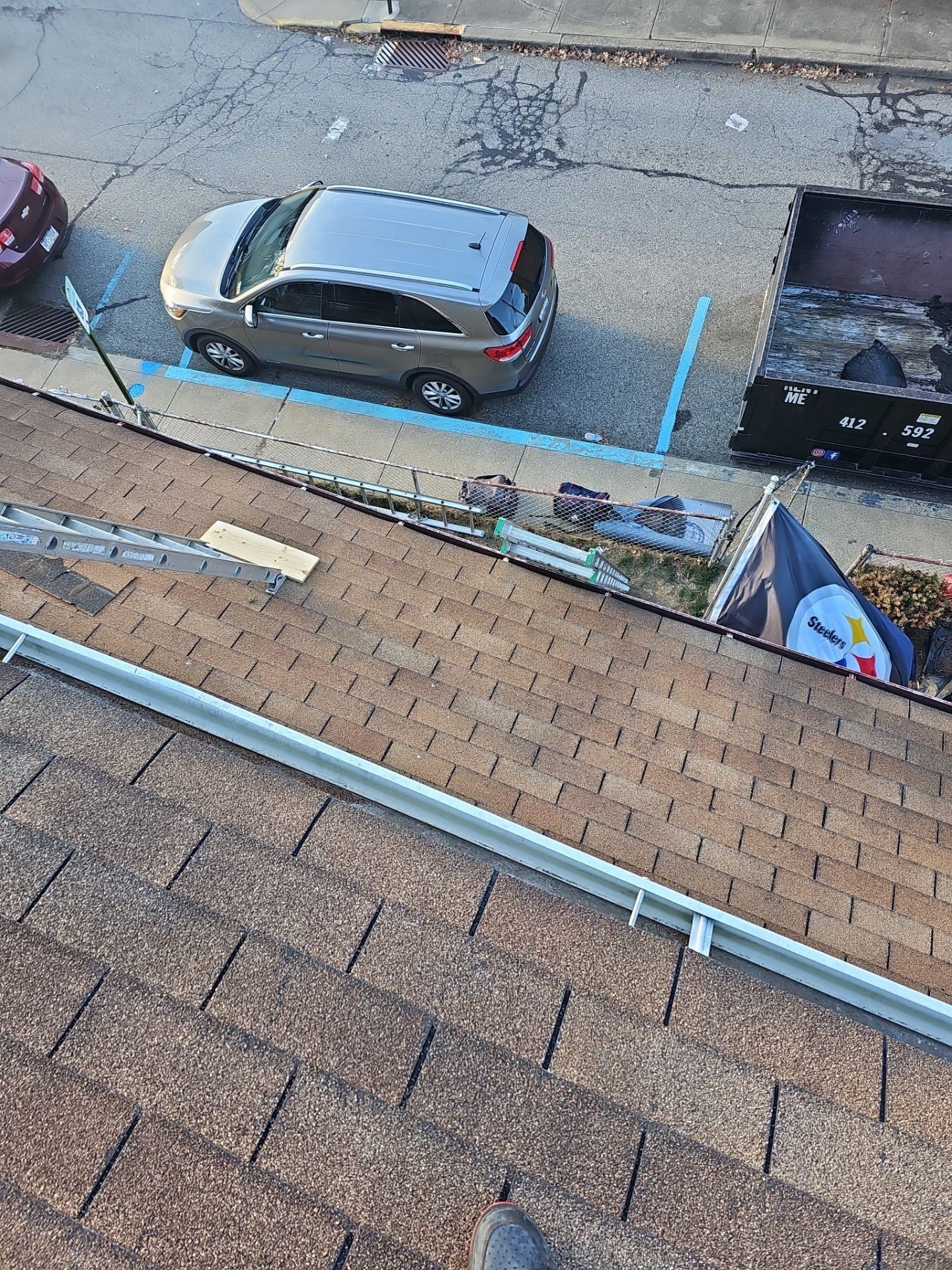
Brown shingles and metal drip edge on a Pittsburgh roof, Alan Construction.
Prevention is where you actually get leverage. Trim branches back well away from the roofline. Clean gutters twice a year so water doesn’t back up under the first course. Add downspout diverters where an upper roof dumps onto a lower one. And check your attic ventilation, which we’ll come back to in a moment. None of it restores lost granules, but all of it slows the next round.
Is granule loss covered by insurance?
Usually not, and the reason is worth understanding. Insurers treat uniform, long term granule loss as wear and tear, an excluded and predictable part of owning a roof. Sudden loss caused by a specific event, like a hailstorm with a date attached, is a different category and is often covered.
So the claim hinges on evidence. Adjusters look for hail bruising, fractures in the mat, directional damage and matching dents on soft metals like gutters and vent caps. Note the storm date, photograph your gutters and downspouts, and get an inspection within your policy’s reporting window. Waiting two years and calling it storm damage rarely goes anywhere. We work with homeowners insurance on storm claims and can meet the adjuster on your roof.
The attic detail almost everyone misses
Shadyside is full of older homes with ventilation that was improvised or blocked over the years, and that combination can cook shingles from underneath. When hot air stalls in an attic without enough ventilation, the shingle surface runs hotter, the asphalt bakes, and granules let go earlier than they should.
If your roof is shedding unevenly and it’s nowhere near old enough to, look up before you look out. Blocked soffit vents and missing ridge ventilation explain a surprising number of early failures. Our post on why proper attic ventilation matters explains what to check.
When replacement beats repair
The math is straightforward. A younger roof with isolated damage is usually worth repairing. An older roof with widespread bald patches, curling edges and gutters that fill with grit every spring is one where repairs only postpone the inevitable. Our guide to roof replacement vs. repair in Pittsburgh walks through that decision in more detail.
If it does come to replacement, we install Atlas shingles, including Pinnacle Pristine, which uses 3M Scotchgard Protector to resist the algae streaks that shaded East End roofs are prone to.
What we’d do this week
Start at the ground. Walk your perimeter, check every downspout outlet, and note what’s collecting. Then step back across the street and study each slope for color differences; bring binoculars if you have them. Photograph anything that looks patchy so you have a baseline for next year.
Stay off the roof. Walking on hot, aging shingles causes the exact damage you’re trying to assess. If what you find checks two or more boxes on the table above, bring in someone who can read the signs properly and tell you honestly whether you have years left or months. We work across Shadyside and the rest of the East End.
Most roofs give you plenty of warning. The grit in your gutter is the warning.
Seeing grit in your gutters or dark patches on your roof? Ask for a free, no obligation estimate and we’ll tell you honestly what we find.